Week of May 3-9, 2026
If you're old enough, do you remember seeing Halley's Comet — the most famous of all celestial nomads — when it swung past our neck of the cosmic woods in 1986?
I did, and I wasn't terribly impressed. It was arguably one of the comet's worst appearances in some 2,000 years. And do you know when one of its best will be? When it returns in July of 2061.
Now, I know what you're thinking — that you may not be around at that time to see it. Personally, I'm looking forward to it. Of course, I'll be nearly 110 years old, and I suppose I'll be quite thrilled just to see the sun rise, but that's my plan, anyway.
In case we don't make it, it's good to have a backup strategy. But you'll have to be willing to rise early and head out to a dark rural location this week.
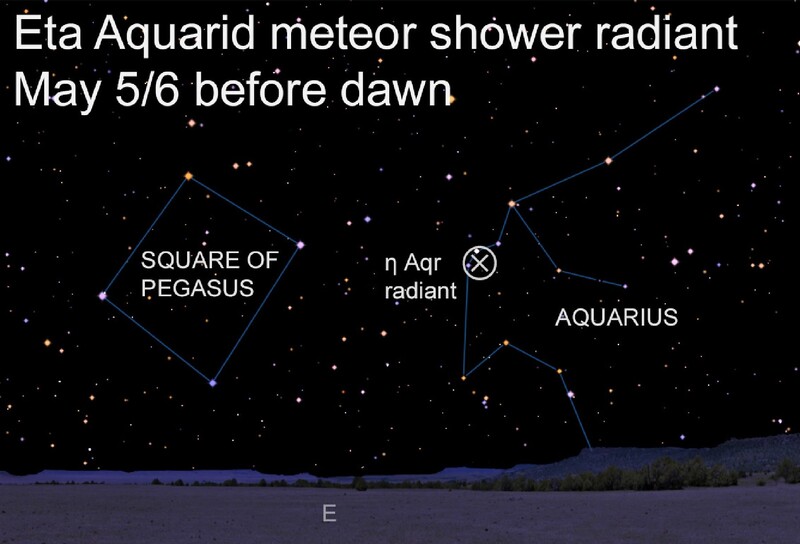
On the mornings of May 5 and 6, fragments of this most famous of comets will pelt our planet's atmosphere in what astronomers call the Eta Aquarid meteor shower.
Meteors, or shooting stars, are specks of interplanetary dust hardly larger than a sand grain that fall into our atmosphere at speeds of tens of miles per second. As one of these slams into the air, it ignites and causes the neighboring atmospheric gases to glow. It's this fiery demise that we see as a meteor.
Those of the Eta Aquarid meteor shower are known to be pieces that have fallen off Comet Halley during one of its many trips past our planet. Though historical records suggest that sky watchers have been seeing the Eta Aquarids since about 74 B.C., the shower was not officially "discovered" until Lieutenant Colonel G. L. Tupman recorded it in the year 1870.
These meteors will appear all around the sky, but you can tell if one is part of the Eta Aquarid swarm by tracing its path backward. If it appears to radiate from the direction of Aquarius, low in the east-southeastern sky before dawn, it is almost certainly associated with this swarm. If it appears to originate elsewhere, it's what astronomers call a "sporadic" or random meteor.
To view the celestial show, head away from city lights where the sky is dark and clear. Under ideal conditions, stargazers may see as many as 50 or 60 meteors, or falling stars, every hour, coming from the eastern sky. The best times for viewing will be between midnight and the first light of dawn. On May 5 and 6, the moon appears in its waning gibbous phase, so we may see only the brightest of meteors.
The best part is that all you need to view the shower is your eyes, a lawn chair or sleeping bag, and some warm clothing. While binoculars or telescopes would produce much too narrow a field of view to see the all-sky show, binoculars could be useful to check out any persistent smoke trails left behind by some of the meteors.
Admittedly, the Eta Aquarids shower is not the great comet itself, but it can still be quite a fun show. Besides, it beats waiting 35 years!
Visit Dennis Mammana at dennismammana.com. To read features by other Creators Syndicate writers and cartoonists, visit the Creators Syndicate website at www.creators.com.
On May 5 and 6, stargazers can view the Eta Aquarid meteor shower, made up of fragments of Halley's Comet.







View Comments